
My ethical considerations
Prof.ssa Emanuela Valle
European Specialist in Veterinary and Comparative Nutrition
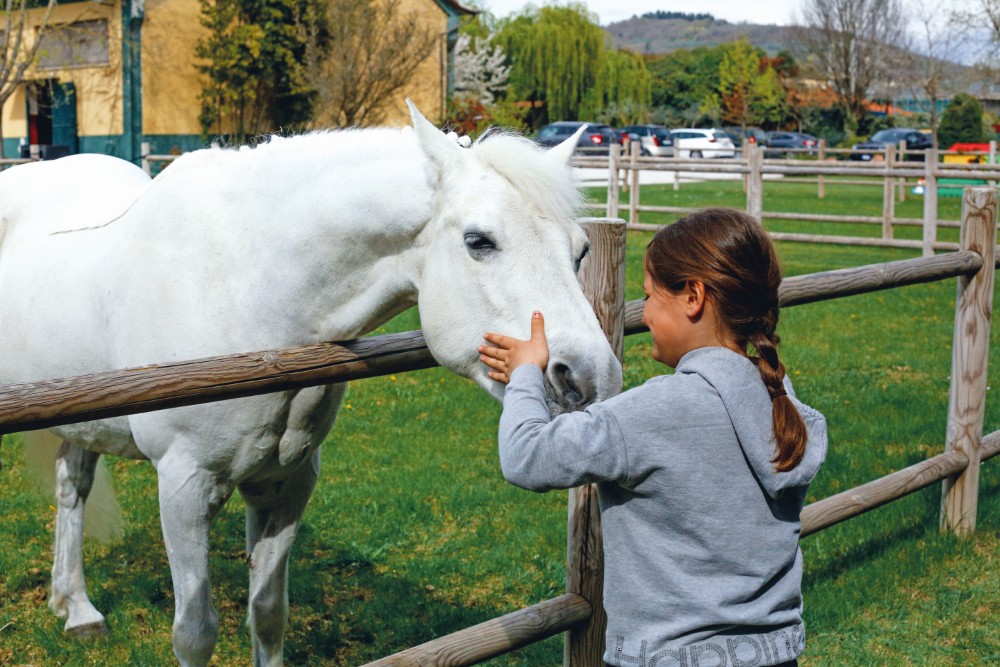
Some encounters don’t happen by chance. There are beings that don’t enter our lives just to stay, but to teach us who we are. For me, the horse is this: a silent being that teaches me awareness of the moment, the stillness of the instant, and the power of presence.
Do you know that moment when you approach a horse? Everything stops.
He immediately stops eating and observes you.
It’s a gaze that weighs and liberates, because in that moment you feel truly seen. It’s not just curiosity, it’s not necessarily mistrust: it’s attention, just simple attention. And as our gazes meet, a thousand questions run through your mind: What does he feel? Will he be afraid? Will he trust me? Will he let me near him? My answer changes every time, because the horse never responds to the person I think I am, but to how I really feel in that precise moment.
Being a horse
The horse, who according to science is capable of perceiving our emotions and experiencing a genuine empathic connection, already knows everything. His survival, in nature, depends on understanding the emotional state of the group and of the beings he interacts with. That’s why he already understood me even before being close to him. And with him, inconsistency cannot be hidden. You can smile, but if he perceives tension through your body, he senses it. He recognises facial expressions, deciphers the smallest details, as Clever Hans did over a century ago, when he intuited responses by reading the subtle signals of human expressions.
He can distinguish a calm face from an angry one, a coherent intention from a mask of control that we humans know so well how to wear. You can tell yourself ‘Don’t worry,’ but if you’re scared inside, he knows it.
The horse is our most honest mirror.
The horse never filters through prejudices:
he doesn’t imagine, he doesn’t judge, he doesn’t project his thoughts to the future because he lives in the present. Science reminds us: horses, not possessing a prefrontal cortex as developed as ours, live in the here and now, in the perceptions of the moment, not in the future . We, on the other hand, live immersed in judgment. We use it as a tool of control even in relationships, including horses. We judge them to be ‘good’ or ‘difficult’, ‘collaborative’, ‘intelligent’ or ‘stubborn’.
By doing so, we are not actually observing them: we are only projecting our anthropocentric vision, the need to measure everything according to human parameters. So, while the horse simply wants to be sincere because every behaviour makes sense only in its context, we risk getting trapped in categories, traditions, and misguided sensations.
Today, however, we are aware of the animal’s biological sensitivity, which allows us to understand that the horse is equipped with his own perception, presence, and relational capacity, anchored in the moment. Therefore, the more our scientific knowledge grows, the greater our responsibility.
Language and Ethics of Awareness
Even changing the words used in equestrian language is a form of awareness, and not a small one. Saying ‘working a horse’ doesn’t do him justice: it’s an expression that carries with it an obsolete legacy, almost of slavery. Likewise, the term ‘training’ doesn’t place the relationship on a reciprocal level. In the human-horse relationship, we are all equal: equal in the right to dignity, respect, and the ability to express ourselves. It’s time for language to reflect this paradigm change.
Ethics and Morality
Writing about ethics today means recognizing that a horse’s well-being can no longer be measured solely through physiological parameters. It means accepting that every horse has a voice, even when his language is silent. It means choosing to be aware, not just competent.
Ethics isn’t just a set of rules or values; it’s the ability to choose consciously. It’s the automatic gesture that translates what we know into what we do. It is not measured by rules, but by the coherence between thought and action, between mind and heart.
Ethics and morality are often confused, but they are not the same thing.
Morality is a social convention: a set of rules, values, and habits that a community or group accepts to define what it deems right or wrong. An example is punishment: I use a whip to punish my horse, and morality, in the past, considered this instrument appropriate.
Ethics, on the other hand, is a more intimate and profound movement: it is reflection, the process through which each of us consciously chooses how to act and why. For example, I can consciously use a whip not as an instrument of punishment, but as an aid to communication, because I know that punishment accentuates fear and pain, becoming counterproductive in the relationship with the horse, increasing only his stress level.
In the relationship with the horse, every gesture, every management choice, every mode of communication becomes an act of responsibility. And this is precisely why there is a need for an Ethical Charter for Horses: not to impose rules, but to give meaning to gestures.
The Five Domains of Animal Welfare
Nutrition, Environment, Health, Behaviour, and Mental wellbeing represent the ideal framework where science and ethics meet.
The ethics of the Five Domains is a form of active understanding: a way of translating knowledge into care, science into empathy, observation into respect.
Ethics shouldn’t be a limit, it should be an open space. A horse that is understood, listened to, and embraced in its profound physical, cognitive, emotional, and social needs is not a trained animal, but an individual who responds, communicates, and expresses himself freely.
Freedom is not a privilege, but a right and a responsibility. The horse, in his powerful and silent presence, lives in constant tension between his nature and our pressures: he cannot be happy if he cannot find space for his authenticity. True equestrian competence does not consist in ‘knowing how to do,’ but in ‘knowing how to consciously act.’