
The horse, a distinguished prodigy throughout the times
Susanna Cottica
This article synthesises the beliefs of Colonel Lodovico Nava (1929-2016), one of the most distinguished personalities in the history of Italian equestrianism.
An Olympic event rider, he later dedicated his life to training instructors in Italy.
Colonel Nava was the brain of the instructor courses established at Pratoni del Vivaro Federal Equestrian Center. Born in 1929, he passed away in 2016, leaving a huge void in the Italian equestrian world.
His beliefs were extraordinarily modern, demonstrating that there is only one kind of equestrianism.
What is the true meaning of equestrian sports? Is there a fine line between what a horse can do and what he is asked to do?
Thanks to the horse, equestrian sports grant a different, more privileged position to the individual who practices it, rather than to the athletes in other sports.
The rider is not always worthy of this privilege and distinction because he often approaches the horse without the culture and competence his companion requires.
The harsh rule of this sport, dictated by the horse, lies in the time required for both horse and rider to mature, reaching the peak of fitness, experience, and career a little bit later in life.
Young people, often listening to contradictory and inconsistent advice, are driven to rush ahead, also influenced by modern society.
In the constant evolution of every aspect of life, the truth is that the essence of equestrian training lies in the constant respect of its nature.
Can we draw comparisons between the methods, the rules, the procedures and the tools that the rider observes and applies with careful, patient, and specific technique to ultimately produce a horse capable of meeting the challenges of a Grand Prix show jumping?
Or what about the tricky and technical courses of eventing at the top-level?
Or the sophisticated and precise displays of movements in a Grand Prix dressage? Sometimes, the man that has interest in applying the old fashioned methods, is psychologically and traditionally drawn by a perverse logic that leads him, through inertia or ignorance, to think and believe that the horse can do everything that he is asked using methods, rules, and practical applications, traceable to a single source, the product of a unique form of equitation.
Sometimes the man wants to remain faithful to his beliefs and to the legacy of an ancient and glorious history, only to then (necessarily) contradict himself in the practical application.
It is useful to remember how, over the years, equestrianism, which encompasses the history of both horses and men, has undergone transformations of great technical and popular significance.
If we look at the traditional equitation, known as High School or Superior Equitation, which in the centuries preceded the birth of Caprilli’s Natural Equitation System, we can see that horses were required to perform artistic displays in military equestrian centers or in the theaters of royal houses, in the form of figures and movements that had little to do with their nature.
There are numerous publications, written by illustrious French and Italian riders and equestrian experts who have studied the mysteries, the rules, and the methods of this High School or Superior Equitation.
Such artistic expression was achieved by applying methods (often coercive) to which the horse adapted, accepting the imposition because of his easy and natural ability to be trained, becoming a resigned performer of everything he was asked to do.
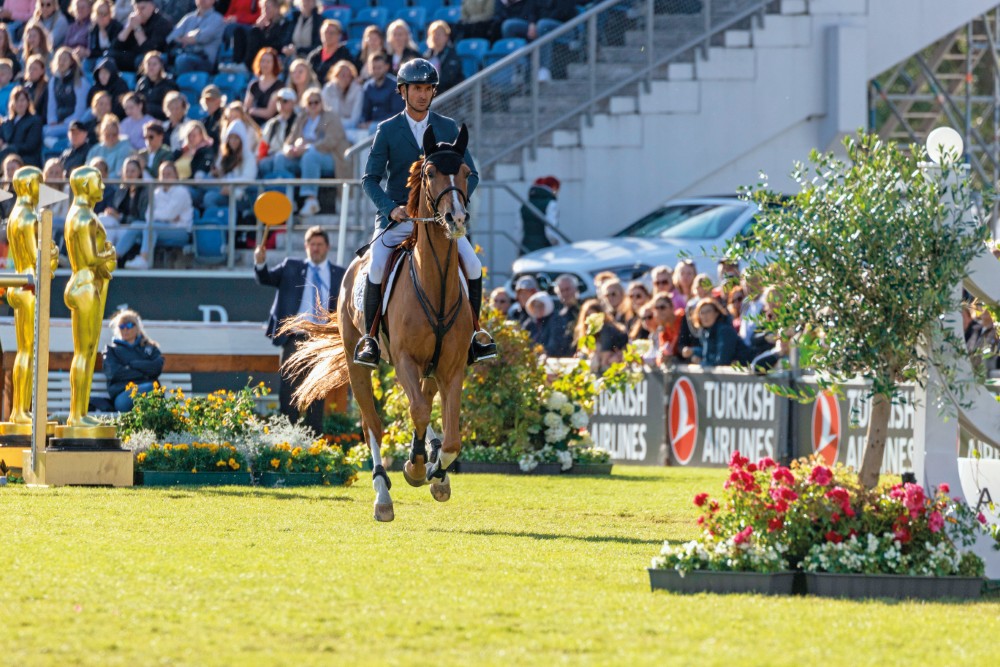
– Aachen,
– 6 July 2024
– ph.Stefano Secchi/ Imagess
The Meaning of Equestrianism
At this point, it’s worth reflecting on the meaning of the word ‘Equestrianism’, viewed and judged as an equestrian art, not as a science or as a collection of purely technical rules. In a nutshell, it’s often said to be ‘the art of good riding’.
But this isn’t enough to fully understand its true meaning.
A true artist strives to shape a living creature, a particularly sensitive being with a personality and character that aren’t always easy, in order to obtain the indispensable obedience and transform him into an athlete capable of facing and overcoming the sometimes very demanding challenges of competitive equestrianism.
This transformation, aimed at developing the horse’s muscular and nervous system in harmonious evolution and balance, occurs following a process where rules, methods and timing are entrusted to the sensitivity, culture, intelligence, experience and moral qualities of the rider.
The word ‘equestrianism’ can therefore take on different meanings.
For the beginner, who is still inexperienced and lacking of balance, one can only speak of ‘elementary’ equitation, designed to build confidence and an initial bond with the horse.
There is no clear cut in the transition to ‘basic’ equitation, as the rider begins to better understand and know their horse.
They feel in control of their balance thanks to a correct position in the saddle, and their posture makes them one with the horse.
They are able to approach their first competitive experiences to a level that gives them the confidence to tackle increasingly significant and important competitive challenges.
Basic equitation, as the word itself suggests, can be described as a building with solid foundations.
It engages the personality and enhances the human and technical qualities, as well as the experience of the instructor, who must, above all, have a good understanding of the horse.
Ambition
As in all sports, the maturity of the athlete, in our case the combination of horse and rider, sees the rider succumb to the desire and legitimate ambition to climb the ladder that leads to the top.
It’s a physiological law of sport. When the rider decides to step up and choose one of the disciplines that characterize equestrian sports, basic equitation shifts to a higher and more specialized level, bringing with it valuable and indispensable lessons that the combination has benefited from.
Caprilli himself spoke of a ‘modern’ equitation that was intended to replace the one popular at the time.
The Natural Equitation System, which he conceived and established, radically changed the way horse and rider were trained for cross-country and show jumping competition.
It was a historic turning point because it established that equestrianism could not be understood as an abstract concept unless it was intended for sport, without losing or diminishing the artistic value of its essence.
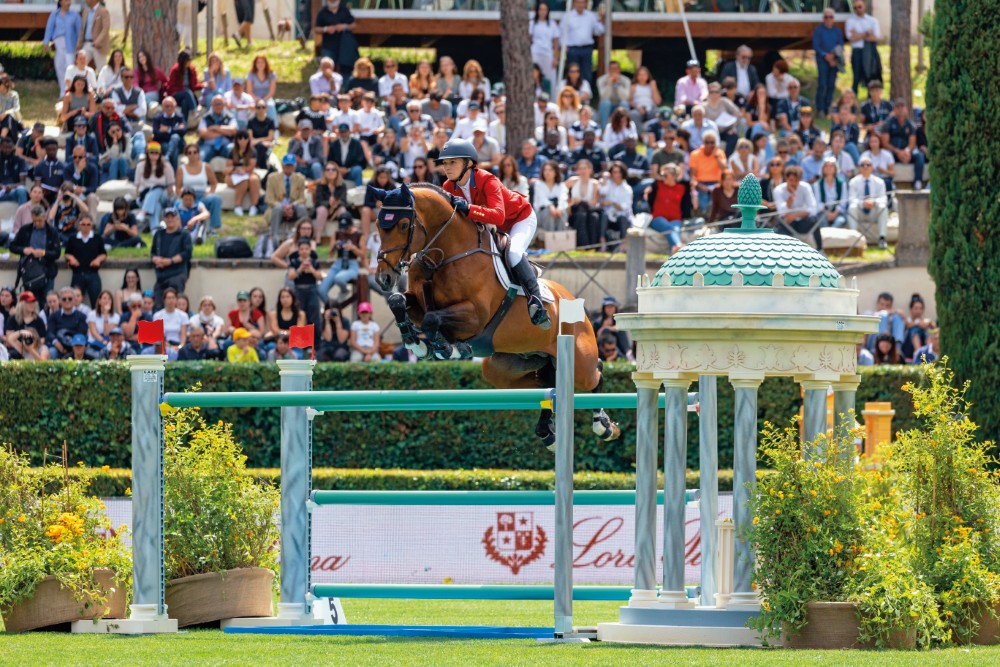
– Roma , Piazza di Siena
– 23 May 2025
– ph.Stefano Secchi
Equestrian Sports and Olympic Disciplines
Equestrian sports are divided into a wide variety of disciplines. The three included in the Olympic calendars are the most historic and have an illustrious tradition.
Each of these is distinguished from the others by the specific and particular psycho-physical preparation of the horse, together with a specific aptitude for that discipline.
Equally important, the rider establishes a relationship with his horse, where the understanding must be complete, as well as the preparation and training.
The rider who has chosen to pursue one of the three disciplines, with the desire and ambition of entering the great stage of world competition, while benefiting from the knowledge acquired in basic equitation, feels the need to refine, through more in-depth application, his technical and competitive experience.
He must follow the rules of a specialized equestrianism in order to develop a horse-athlete capable of handling new and highly demanding situations.
The passing of time, as dictated by human history, brings a change and transformation in customs and ways of understanding the sport, sometimes exaggerated by excessive media interest.
The presence of the horse, as the main and unique protagonist, has elevated the equestrian sports, which has become more popular than ever. However, man has a moral duty to protect the horses’ well-being against the excesses of competitiveness.
Moral and Non-Moral Qualities
The importance of moral qualities cannot be overlooked. First and foremost, the most obvious, is the love for the horse. A feeling that must lead man to always respect him and to consider him a companion in competition, never a tool. Unfortunately, ambition and the desire to excel, combined with relentless business, create a barrier that divides the rider from the horse, and the authentic rider from the amateur.
Moral values, respect, and generosity are linked to the culture, sensitivity, and nobility of the soul of those who grants it.